From Influence to Attribution: What Affiliate Summit West and Creator Economy Live Revealed About Modern Marketing
January 21, 2026
Key Takeaways from Affiliate Summit West and Creator Economy Live
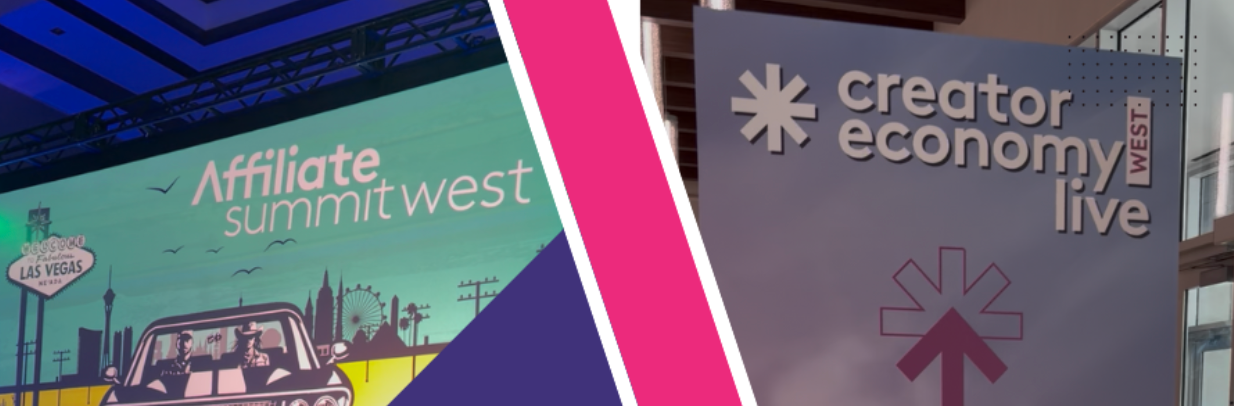
Stampede Social recently attended two conferences back-to-back in Las Vegas: Affiliate Summit West and Creator Economy Live West.
On the surface, they serve very different audiences.
Affiliate Summit West leans heavily into performance marketing, tracking, commerce infrastructure, and attribution. Creator Economy Live focuses on creators, influence, brand partnerships, and trust.
But sitting in those rooms, listening to the conversations, and reviewing my notes afterward, something became very clear:
Despite approaching the industry from opposite directions, both conferences kept circling the same tension.
We are still measuring marketing as if outcomes happen in one moment, even though influence clearly does not.
That disconnect is why vanity metrics are failing us. And it’s why attribution is becoming the most important conversation in marketing right now.
Influence Now Happens Earlier Than Attribution Can See
One of the strongest themes at Affiliate Summit West was how discovery itself is changing.
In a session led by Lily Ray of Amsive, the discussion focused on the evolving state of search and AI. The key takeaway wasn’t that Google is disappearing or that everyone has suddenly switched to ChatGPT. In fact, only a small percentage of people rely exclusively on AI for search.

What has changed is how fragmented discovery has become.
AI-powered search is increasingly personal. Two people can ask the same question and receive entirely different results based on context, behavior, and prior interactions. Social media, user-generated content, reviews, and third-party mentions now play a much larger role in shaping what information surfaces and which brands are trusted.

In other words, discovery no longer has a single starting point.
That matters because most attribution models still assume it does.
When Discovery Fragments, Last-Click Attribution Collapses
Affiliate Summit West featured a lot of discussion around tracking, retail media networks, connected media, and where affiliate fits as commerce continues to evolve. Across those conversations, there was a quiet acknowledgment that last-click attribution simply cannot explain modern performance.
Meanwhile, at Creator Economy Live, creators were being discussed as powerful drivers of awareness, consideration, and intent, even when they never directly close the sale.

This is where the disconnect shows up.
A creator introduces a product.
Another creator reinforces trust.
A paid ad captures intent.
An affiliate link closes the transaction.
Last-click attribution credits only the final step and ignores everything that made the conversion possible.
The result is predictable: channels that influence early or mid-funnel decisions look inefficient, while channels closer to the point of purchase appear to overperform.
The problem isn’t influence. It’s measurement.
Influence Doesn’t Happen in One Moment
One of the clearest visual narratives across the sessions was the buyer journey itself: awareness, consideration, intent, and conversion.
That journey rarely happens in a straight line, and it almost never happens in a single interaction.
Creators play different roles along that path. Some are exceptional at introducing a brand to a new audience. Others are better at explaining products, answering questions, or demonstrating real-world use. Expecting every creator to perform equally at conversion is not just unrealistic, it actively distorts results.
Several sessions reinforced the same idea: start with the funnel, not the outcome.

Before launching a campaign, brands need to decide which part of the funnel they are testing. Each creator should have one primary objective, not all of them. When brands skip this step, they end up evaluating creators against mismatched KPIs and calling programs “unsuccessful” far too early.
TikTok Shop Shows What Happens When the Funnel Collapses
A dedicated Affiliate Summit West session on TikTok Shop made this especially tangible.
Presented by Navi Singh of Sohva, the session focused on how social commerce is collapsing the traditional funnel into a single experience: watch, want, buy.
What stood out was how different success looks in this environment.
Highly polished videos are not the priority. Short-form content that hooks viewers within the first two seconds performs better. Product demonstrations convert more effectively than aesthetic storytelling. Quantity matters more than perfection, and live selling is outperforming static video.
Perhaps most notably, follower count matters far less than trust and relevance.
TikTok Shop is not just a new sales channel. It’s a preview of what happens when content, influence, and commerce fully converge. It also highlights why attribution becomes harder, not easier, as platforms evolve.
Creators Are Becoming Infrastructure, Not Just Distribution
At Creator Economy Live, the conversation repeatedly returned to the idea that creators are no longer just distribution channels. In many cases, they are becoming infrastructure.
Some speakers described top creators as the modern equivalent of QVC for platforms like Instagram and TikTok. These creators don’t just drive awareness. They educate audiences, shape perception, generate feedback, and influence purchasing decisions across time.
A session led by Lisa Zlotnick, Head of Brand PR at SHEIN, reinforced this point. Real brand connection, she emphasized, is built intentionally. The strongest partnerships come from listening more than broadcasting and treating creators as partners rather than placements.
Creators produce something brands often struggle to get on their own: real-time customer insight, delivered in the language their audience already trusts.

Why Influencer Measurement Keeps Breaking
Several slides across sessions captured the frustration many teams feel when influencer programs don’t deliver immediate results.
Measurement tends to break down when brands expect instant outcomes, over-index on last-click attribution, evaluate all creators against the same KPIs, or set rigid goals too early in a partnership.
Another important nuance surfaced: underperformance is often a brand-fit or audience-fit issue, not a creator performance issue.
Flat KPIs for a few weeks do not signal failure. Consistently flat performance over multiple months after optimization does. Even then, many sessions emphasized the value of asking creators for feedback before exiting a partnership. Creators often see friction points brands don’t.
What Better Measurement Actually Looks Like
Across both conferences, a more mature measurement framework began to emerge.
At the creator level, performance should improve month over month, beat internal baselines, and align with the creator’s role in the funnel. Awareness creators should be judged on reach quality and engagement, not revenue. Consideration of creators on traffic quality and CTR. Conversion-focused creators on CPA and ROI.
At the business level, effective influencer programs show up as broader lift: increased website traffic, higher brand search volume, improved on-site engagement, stronger paid performance, and better efficiency across affiliate, email, and CRM channels.
This is why influencer ROI is better understood as a trajectory rather than a moment. When it works, performance improves across the funnel and across the business, not just at the point of conversion.
Where Affiliate Fits When It’s Used Correctly
One of the clearest bridges between Affiliate Summit West and Creator Economy Live was the evolving role of affiliate itself.
Affiliate is no longer just a channel. It is increasingly a measurement layer.
When implemented well, affiliate data helps connect creators to intent and outcomes, identify assisted value, and explain why performance is changing rather than simply assigning credit for conversions.
That framing showed up repeatedly in conversations at both events. Attribution models that focus on explanation instead of just credit give brands the clarity they need to optimize without dismantling programs that are actually working.
The Shared Message From Both Conferences
Despite their different audiences, both conferences ultimately pointed to the same conclusion.
AI is reshaping discovery. Creators are shaping trust. Social commerce is compressing the funnel. And attribution models must evolve to reflect how influence actually works.
Vanity metrics are not useless, but they are incomplete. Likes, views, and clicks are signals, not answers.
The brands that win next will be the ones that measure influence across time, respect the full buyer journey, and optimize based on learning rather than panic.
That shift from vanity metrics to attribution isn’t about better dashboards. It’s about better decisions.
And it’s becoming clear that the future of marketing depends on getting it right.
Where Stampede Social Fits
Modern influence doesn’t happen in one moment, and attribution can’t either.
Stampede Social helps brands and agencies track real signals across the journey by turning comments, Lives, and creator CTAs into measurable actions. Instead of relying on last-click credit, teams can see which creators, posts, and moments actually drive intent, understand assisted value over time, and make smarter decisions without killing what’s working.
Influence creates momentum.
Stampede Social helps you measure it.
FAQs: Influence, Attribution, and Measurement
Why is last-click attribution no longer accurate in modern marketing?
Last-click attribution only credits the final interaction before a purchase, ignoring the creators, content, and touchpoints that build awareness and trust earlier in the buyer journey. This makes upper- and mid-funnel efforts appear less effective than they actually are.
How does influencer marketing impact attribution and ROI?
Describe the item or answer the question so that site visitors who are Influencer marketing influences discovery, consideration, and intent over time. Its impact often appears indirectly through assisted conversions, branded search lift, improved click-through rates, and stronger downstream channel performance rather than immediate sales. get more information. You can emphasize this text with bullets, italics or bold, and add links.
What is better attribution in influencer and creator marketing?
Better attribution focuses on contribution instead of credit. It tracks meaningful signals across the funnel—engagement, intent, and follow-on actions—to explain why performance changes, not just where a conversion happened.
How should brands measure creator performance more accurately?
Creators should be evaluated based on their role in the funnel. Awareness creators should be measured on reach quality and engagement, consideration creators on traffic quality and intent signals, and conversion-focused creators on CPA and ROI.
Where does affiliate marketing fit in modern attribution models?
Affiliate marketing increasingly functions as a measurement layer rather than just a commission channel. When used correctly, affiliate data helps identify assisted value, connect influence to outcomes, and clarify how different touchpoints contribute to performance.
How does Stampede Social help with attribution for influencer marketing?
Stampede Social helps brands track attribution beyond last-click by turning comments, DMs, Lives, and creator CTAs into measurable actions. This allows teams to see which creators, posts, and moments drive intent over time and understand assisted impact across the buyer journey.